
Suze
A French bittersweet aperitif liqueur made from gentian root, with an herbal, faintly medicinal flavor - key to the modern classic Kingston Negroni.
Origin
Maisons-Alfort, near Paris, France, created for the 1889 Paris World's Fair by Ferdinand Moureaux and Henri Forte.
History
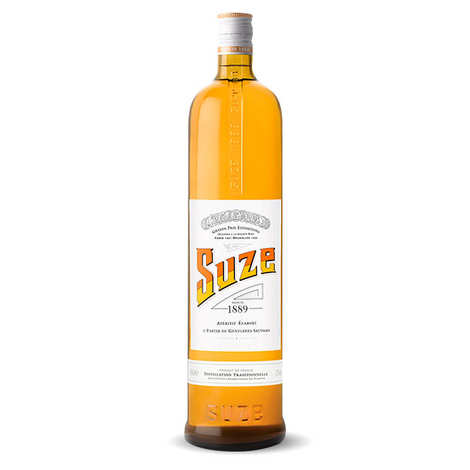
Ferdinand Moureaux, running his family's distillery near Paris, and his partner Henri Forte developed Suze for the 1889 Paris World's Fair, originally naming it Picotin (an old French term for a dry grain measure) before renaming it Suze in 1898, a change whose exact inspiration (Moureaux's sister-in-law Susanne, or Switzerland's Suze river) remains uncertain. Its bottle, designed by Forte, has remained essentially unchanged since 1896, and the liqueur achieved a different kind of fame in 1912 when Pablo Picasso featured a Suze bottle in his Cubist collage "Verre et bouteille de Suze," cementing its place in French cultural history well beyond the bar. Pernod Ricard has owned the brand since 1965.
Flavor profile
Intensely bitter and earthy, built primarily around gentian root, with a distinctive vegetal, slightly medicinal edge.
Tasting notes
A sharp, root-forward bitterness dominates, quite different from citrus-peel-based bitter aperitifs like Aperol or Campari, giving cocktails like the White Negroni (which uses Suze in place of Campari) a more earthy, herbal character than the original.
Substitutes
- A different gentian-based liqueur (like Salers or Avèze), for a very close substitute given the shared main botanical.
- Campari, for a related but distinctly citrus-forward, differently bitter substitute.
- Cynar, for a different but comparably vegetal, bitter Italian substitute.
Common cocktails